


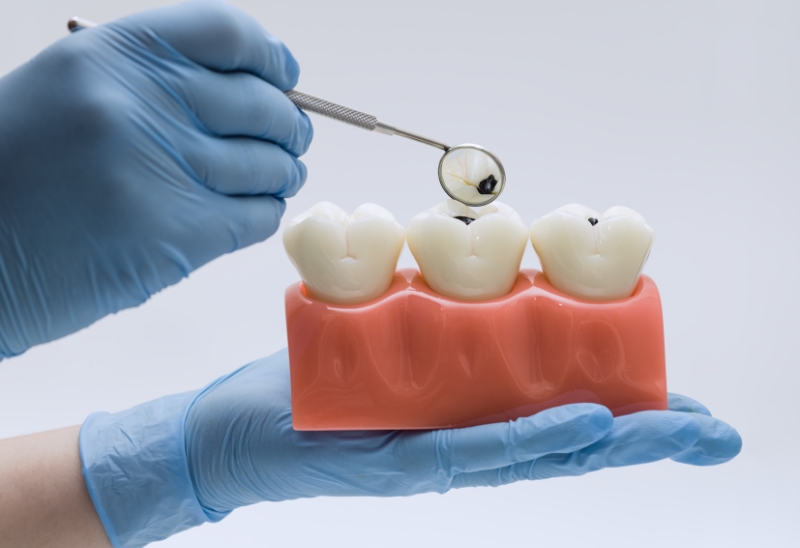
Tooth decay doesn't always remain a small, easily treatable lesion. In many cases, when detected early, it can be resolved with a filling. However, when it progresses and affects deeper layers of the tooth, treatment can be more complex.
Many people think that if there isn't a pain While a deep cavity may not be a major problem, it's true that some cavities can progress for a while without showing very clear symptoms. Therefore, knowing the signs that a cavity is no longer superficial helps you get checked before the problem worsens.
In Asistencia Dental Plus, Your dental clinic in Valencia, We frequently see cases where a timely review makes the difference between a simple conservative treatment and a more complex procedure. preserve the tooth.
Content
When can a cavity be treated with a filling?
A dental filling is usually sufficient when the decay is in an initial or moderate stage and has not yet significantly affected the internal structures of the tooth.
In these cases, treatment involves removing the damaged tissue and reconstructing the affected area to restore the tooth's shape and function. The key is to detect the lesion before it reaches deeper layers.
That's why regular checkups are so important. They allow us to identify cavities that haven't yet caused intense pain, but that already need treatment to prevent them from progressing.
When does a cavity cease to be superficial?
A cavity ceases to be superficial when it no longer only affects the outer layer of the tooth, but advances to deeper areas, such as the dentin or even the dental pulp.
The pulp is the inner part of the tooth where the nerve and blood vessels are located. When the infection reaches this area, the problem is no longer a simple cavity and may require more complex treatments to try to save the tooth.
It's not always possible to know for sure based on symptoms alone. Sometimes the patient experiences clear discomfort, but other times it's the clinical and radiographic examination that reveals the extent of the damage.
Signs that a cavity may need more than a filling
There are certain signs that may suggest that tooth decay is no longer in a superficial stage and that it should be checked as soon as possible.
Spontaneous toothache
When pain occurs without eating or drinking anything, especially if it is sharp, persistent, or intermittent, it may be a sign that tooth decay has progressed and is affecting deeper areas of the tooth.
Intense sensitivity or sensitivity that lasts for several seconds
It is relatively common to notice some sensitivity with a cavity, but when that discomfort is intense or remains for a while after consuming something cold, hot, or sweet, it may indicate a deeper problem.
Pain when chewing
If you experience pain, pressure, or discomfort in a specific tooth when biting, it's worth having it checked. In some cases, this could be due to advanced decay that has weakened the tooth or affected the nerve.
Tooth discoloration
A dark, brown, or grayish stain can be a visible sign of tooth decay. When the tooth also changes appearance more noticeably, it may indicate that the lesion has progressed further than it appears externally.
Visible hole or fracture in part of the tooth
When a cavity is already visible or the tooth breaks due to weakening, the decay has likely been progressing for some time. In these cases, a conventional filling is not always sufficient.
Inflammation or appearance of phlegmon
If you experience gum inflammation, a feeling of pressure, a bad taste in your mouth, or even an abscess, the infection may have spread beyond the tooth and is affecting the surrounding tissues. In this situation, it is essential to see a dentist as soon as possible.
Persistent bad breath or unpleasant taste
Although it is not always directly related to a deep cavity, in some cases an advanced infection can be accompanied by bad breath or a persistent unpleasant taste in the mouth.
What can happen if tooth decay is left untreated?
When tooth decay is not treated in time, it can continue to destroy tooth tissue and increasingly compromise the tooth structure.
As it progresses, the risk of the following increases:
- more intense tooth pain
- nerve infection
- need for endodontics
- weakening or fracture of the piece
- abscesses or phlegmons
- tooth loss in the most advanced cases
Therefore, even if the symptom seems minor or intermittent, it's best not to wait too long. In restorative dentistry, early intervention usually allows for simpler treatments and better preservation of the tooth's natural structure.
Not all advanced cavities hurt the same.
It's important to keep in mind that not all deep cavities cause intense pain from the start. Some progress slowly and give more subtle signs, such as occasional sensitivity, mild discomfort, or slight changes in tooth color.
This causes many people to delay seeking dental care, thinking it's not serious yet. However, when the pain becomes clear, in some cases the cavity has already progressed quite far.
Therefore, if you have any doubts, it is best to assess the situation in a clinic and check the actual condition of the piece.
The importance of a timely check-up
Detecting tooth decay before it progresses too far can make a big difference in treatment. A timely checkup allows for an assessment of the depth of the lesion, the condition of the tooth, and the best option for saving it.
At Asistencia Dental Plus, in Valencia, we carry out an individualized assessment of each case to accurately diagnose whether the cavity can be resolved with conservative treatment or if it requires a more complex intervention.
Treating a cavity early is taking care of your teeth in the long run.
In many cases, treating tooth decay in its early stages allows you to preserve more tooth structure and avoid future complications. Therefore, even if the discomfort is mild or only occurs occasionally, it's best not to ignore it.
Furthermore, in Asistencia Dental Plus, At your dental clinic in Valencia, we work under rigorous clinical protocols and have the Certificate of Dental Excellence DentalQuality, a recognition that endorses our commitment to quality, prevention and personalized attention.
If you notice sensitivity, pain when chewing, a stain on a tooth, or any other sign that makes you suspect a cavity, a timely check-up can help prevent the problem from progressing.
You can contact us at the 963 16 26 56 Or you can request an appointment through our contact page. We'll be happy to help you take care of your oral health with peace of mind and confidence.