


Losing a tooth may initially seem like a primarily cosmetic problem, especially when the missing tooth is in a less visible area. However, in Asistencia Dental Plus, Dental clinic in Valencia, We emphasize that replacing a missing tooth is also important to protect the function of the mouth and avoid changes that can complicate treatment over time.
Teeth form an interconnected system. Each tooth helps maintain the position of the others, distribute forces correctly during chewing, and preserve bite balance.
That's why, When a tooth is missing, the whole mouth can begin to adapt to that empty space..
Content
What happens when we lose a tooth?
After a tooth extraction or loss, the body begins a natural remodeling process. The bone that supported the root no longer receives the stimulus of chewing and may gradually decrease in volume.
At the same time, the adjacent teeth may shift or tilt toward the gap. The opposing tooth, that is, the one that bit against the missing tooth, may also move because it no longer has its usual contact.
These changes are not always immediately noticeable. They can progress slowly and become evident months or even years later.
Consequences of not replacing a missing tooth
Although each patient presents a different situation, waiting too long can lead to several problems.
Movement of nearby teeth
The teeth next to the gap may tilt or shift. This alters tooth alignment and can create hard-to-clean areas, increasing plaque buildup.
Changes in bite
When teeth shift position, the contact between the upper and lower teeth is no longer balanced. This can alter the bite and affect chewing.
Overload of other teeth
When a tooth is missing, it's common for the patient to chew more on the opposite side. The remaining teeth must bear an additional load, which can lead to wear, sensitivity, or fracture.
Loss of chewing function
The absence of a tooth can make it difficult to chew food properly. This limitation is especially significant when several teeth are missing or when the loss affects the molars, which play a fundamental role in chewing.
Progressive bone loss
The tooth root transmits the stimulus generated by chewing to the bone. When it disappears, the bone in that area can begin to resorb.
This bone loss can make tooth replacement more complex in the future. In some cases, additional procedures may be necessary before placing an implant.
How long can you wait to replace a tooth?
There is no single timeframe that applies to all patients. It depends on the cause of the loss, the affected area, the condition of the bone, the health of the gums, and the overall condition of the mouth.
In some cases, replacement can be planned shortly after extraction. In others, it is necessary to wait for the tissues to heal or to undergo some other treatment beforehand.
The important thing is Do not confuse the waiting time indicated by the dentist with leaving the problem unassessed.. Even if the tooth was recently lost, it is advisable to study the situation and establish a plan from the beginning.
How can a missing tooth be replaced?
There are different alternatives and the choice should be made after an individualized exploration and study.
Dental implant
The dental implants They allow the replacement of the tooth root with a structure that integrates with the bone. A crown, designed to restore the aesthetics and function of the missing tooth, is then placed on top of this structure.
One of its main advantages is that it allows the tooth to be replaced without relying on neighboring teeth. However, to recommend this treatment, it is necessary to assess the condition of the bone, gums, bite, and the patient's overall health.
Dental bridge
A bridge is a fixed prosthesis that replaces a missing tooth by relying on nearby teeth or, in certain treatments, on implants.
It can be a suitable alternative for some patients, especially when adjacent teeth already need restoration. Its suitability will depend on the condition of those teeth and the characteristics of the available space.
Removable dental prosthesis
The removable dental prostheses They allow the replacement of one or more pieces and can be an option when a fixed treatment is not indicated or when several teeth need to be replaced.
Currently, there are different designs and materials that allow the prosthesis to be adapted to the functional and aesthetic needs of each patient.
Which treatment is most appropriate?
There is no single solution that works for everyone. To choose correctly, it is necessary to study:
- The number and position of the missing teeth.
- The quantity and quality of available bone.
- Gum health.
- The condition of the adjacent teeth.
- The bite and the distribution of forces.
- Hygiene and maintenance habits.
- The patient's functional and aesthetic needs.
The goal should not only be to close the visible gap, but to restore balanced chewing and achieve a stable long-term result.
Early assessment facilitates treatment
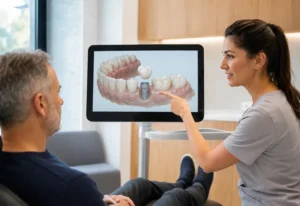
Seeking early consultation doesn't mean treatment has to be done immediately. It means understanding the condition of your mouth, evaluating different options, and preventing further uncontrolled changes to your teeth, bone, and bite.
If you have lost a tooth, even if it doesn't cause you pain or isn't visible when you smile, a professional assessment will help determine what is happening and the best time to act.
Furthermore, in Asistencia Dental Plus We work under rigorous clinical protocols and have the Certificate of Dental Excellence DentalQuality, a recognition that endorses our commitment to quality, prevention and personalized attention.
You can contact us at the 963 16 26 56 o Request your appointment through our contact form.
We will be happy to accompany you to take care of your oral health with peace of mind and confidence.