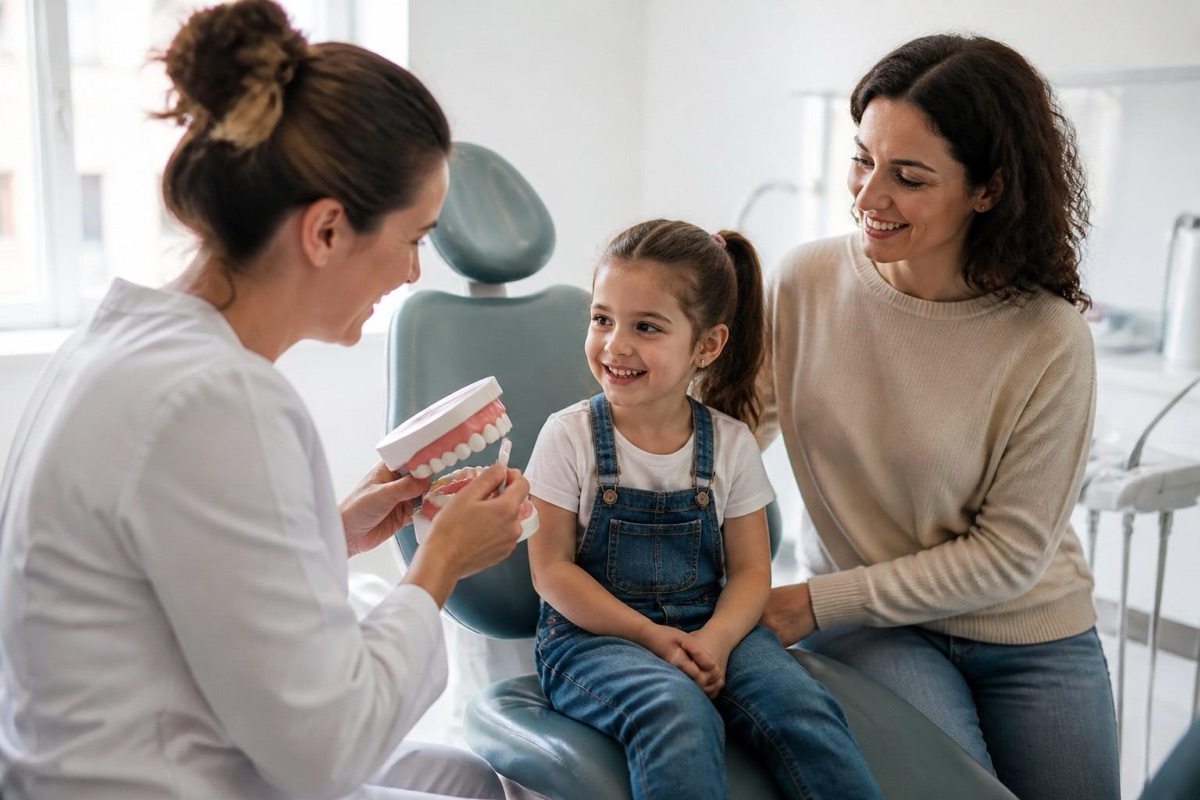
Around the age of six, many children unknowingly develop their first permanent molar. It appears at the back of the mouth, behind the baby teeth, and doesn't replace any tooth that has fallen out. That's why it often goes unnoticed and is frequently mistaken for a baby tooth.
In Asistencia Dental Plus, dental clinic in Valencia, We often see that families only discover a child's six-year molar when it already has a cavity. Detecting it early allows for proper care from day one.
Content
How to recognize the six-year-old molar
It's also known as the first permanent molar. It erupts on each side of the mouth, top and bottom, until you have four molars. To locate it, count from the center back: if a wider tooth with a rough surface and no gap appears behind the last baby tooth, it's likely the first permanent molar.
It's one of the teeth that will do the most work throughout your life. It plays a role in chewing and helps guide how the other permanent teeth fit together. Losing it prematurely can alter your bite, so it's important to protect it.
Why does it need specific care?
During the first few months after erupting, this molar is in a delicate situation:
- The glaze is still maturing. A newly removed piece is more sensitive to plaque acids and sugars.
- Its surface has deep grooves. Food debris accumulates in them and the brush doesn't always reach the bottom.
- It takes a while to come out completely. While the gum partially covers it, it is more difficult to clean and the area can become inflamed.
- It's far behind. Being at the end of the dental arch, it is the one most often forgotten when brushing.
None of this means it will cause problems, but it does deserve more attention than the rest of your teeth.
Care during the eruption
The eruption of a tooth can take several months. During this time, it's advisable to reinforce certain habits:
- Brush thoroughly with a small-headed brush, tilting it to reach the protruding molar.
- Supervise or review brushing. At this age, most children do not yet have the dexterity to properly clean the bottom areas.
- Gently brush the gum surrounding the tooth, without avoiding it even if it bothers me a little.
- Use toothpaste with fluoride in the amount indicated by the pediatric dentist according to age.
- Limit sugars between meals, especially sticky foods and sugary drinks.
If the child complains when chewing, the gums are reddened, or there is localized bad breath, it is advisable to have them checked by a specialist and not wait for it to go away on its own.
What can the specialist assess?
During the checkup, the pediatric dentist examines how the tooth is erupting, the condition of the enamel, and the depth of the grooves. Depending on each case, they may recommend:
- Reinforcement of hygiene, with a technique adapted to the child's age.
- Fluoride applications to strengthen the enamel.
- Crack sealants, a thin layer that protects the grooves of the chewing surface when the molar has already emerged sufficiently.
Not all children need the same treatment. The recommendation depends on each child's risk of cavities and their cooperation during the appointment.
Signs to watch out for
In addition to checkups, there are signs that shouldn't be ignored. None of them alone indicates a cavity, but all warrant a checkup:
- White, brown or black spots on the chewing surface.
- Sensitivity to cold, heat, or sweet foods.
- Discomfort or pain when chewing, or the child avoiding chewing on that side.
- Swollen, reddened, or bleeding gum around the tooth.
- Bad breath that does not improve with good brushing.
How to make brushing easier
At this age, brushing your teeth is often a daily struggle. Here are some ideas to help your child cooperate and make brushing more effective:
- Brush your teeth at the same time as your parents, so that they experience it as a shared routine.
- Let him choose his brush, from among those with small heads and soft bristles.
- Brush in front of a mirror, so that he can see the back area and learn how to reach it.
- Always check before going to sleep, because saliva decreases during the night and the mouth is less protected.
Consistency matters more than perfection. A gentle brushing twice a day, with the help of an adult, usually works better than a long, forced one.
Frequently Asked Questions
Is the six-year molar a baby tooth?
No. It's a permanent tooth and it won't fall out. It comes in between the baby teeth, but it doesn't replace any of them, and if it gets damaged, the child won't have another one to replace it.
At what age does he/she leave?
It usually appears around age six, although it can appear a few months earlier or later without being a problem. If it's not visible by age seven, it should be mentioned during a checkup.
Does it hurt when it comes out?
There may be some discomfort, with sensitive or swollen gums, especially when chewing. If the pain is severe or lasts for several days, it's best to see a specialist.
Can someone get cavities right after birth?
Yes. Due to its surface shape and still-developing enamel, it's one of the teeth most at risk of cavities in children. That's why it's recommended to have it checked early.
When is it advisable to take the child for a check-up?
Ideally, this should be done as soon as the tooth starts to erupt, without waiting for discomfort to appear. An early check-up allows you to assess how the tooth is coming in and adjust your oral hygiene accordingly.
Until what age should you help a child brush their teeth?
There's no exact age. Until the child has the dexterity to clean all areas thoroughly, especially the back teeth, it's best if an adult supervises their brushing. A pediatric dentist can advise on when to give them more independence.
Is it necessary to seal the six-year molar?
Not always. It's assessed based on the depth of the grooves, the risk of cavities, and the child's cooperation. The specialist makes the decision after examining the tooth.
Review in Asistencia Dental Plus
At Asistencia Dental Plus, our specialist in pediatric dentistry We examine the six-year molars using techniques adapted to each child's age and explain clear and simple hygiene guidelines to families. We work under rigorous clinical protocols and have the Certificate of Dental Excellence DentalQuality, a recognition that endorses our commitment to quality, prevention and personalized attention.
You can call us at 963 16 26 56, or write to us by WhatsApp at 658 788 759 or request your appointment through our contact page.
If your child is at the age where their six-year-old molars are coming in, a timely check-up helps ensure they reach adulthood healthy.