
You finish orthodontic treatment, start using your retainer, and after a while, you notice it doesn't fit the same way anymore. It's too tight, difficult to put in, or it's loose. This is more common than you might think, and it shouldn't be ignored.
In Asistencia Dental Plus, dental clinic in Valencia, We see patients who consult us about this issue after their treatment has ended. The important thing is to act promptly and not force the tooth.
Content
Retainer and active aligners: they are not the same
Active aligners are the ones that move the teeth during treatment. Each set is designed for a specific position and is replaced with the next set once it has served its purpose.
The retainer is used after orthodontic treatment is complete and its purpose is to maintain the teeth in the achieved position. It is not intended to move them.
This distinction is important. If a retainer feels very tight, it doesn't mean it's "working" like an aligner. Most likely, the teeth have shifted, and the retainer no longer fits properly.
Why it might stop fitting in
- The teeth have shifted slightly. This is the most frequent cause, especially if there have been days or weeks without using it.
- The retainer has become deformed. Heat, pressure from biting it, or storing it without a case can alter its shape.
- It has broken or worn out with daily use.
- There is plaque or tartar in the piece or on the teeth, which prevents it from seating properly.
- Has any tooth changed?, For example, after a filling or a crown.
From the outside, it's impossible to know which of these causes applies to your case. A medical examination is the only way to find out.
What to do if you notice it doesn't fit
- Don't force it. Pressing it with your fingers or biting down to force it in can damage the retainer and your teeth.
- Do not submerge it in hot water to "soften" it. It can become even more deformed.
- Don't stop using it on your own for weeks, because the teeth can continue to shift.
- Store it in its case and take him to the doctor.
- Request a check-up as soon as possible. The sooner it is checked, the more time there is to find the right solution.
What is assessed in the review
The orthodontist studies several aspects to understand what has happened:
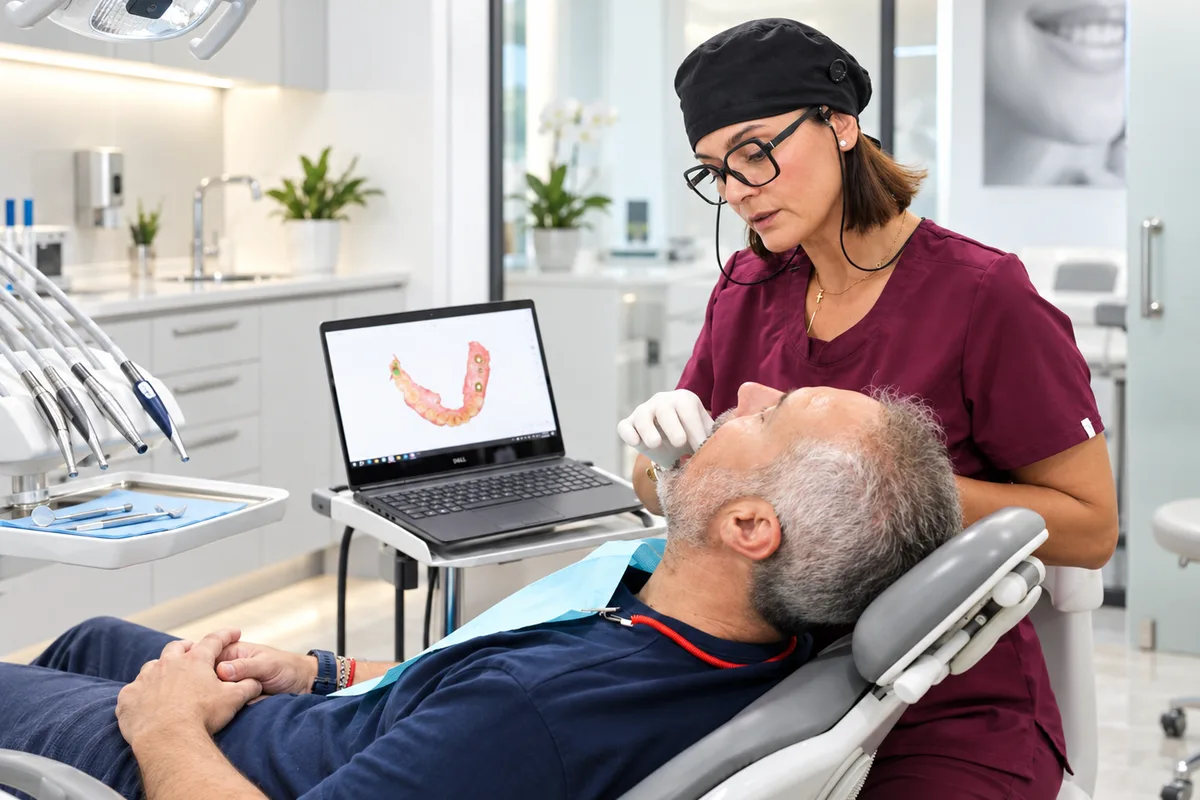
- The current position of the teeth, compared to the one achieved at the end of the treatment.
- The status of the retainer: if it fits, if it is deformed or if it has breaks.
- Bite and gum health.
- How and for how long have you used it?, according to the guidelines they gave you.
With that information, the options are considered. In some cases, adjusting or replacing the retainer is sufficient. In others, if the movement is more significant, a new phase of orthodontic treatment may be necessary. The decision is individual and is explained before any treatment begins.
How to care for your retainer so it continues to fit properly
- Always keep it in its case when you're not wearing it. Wrapping it in a napkin is a common way to lose it.
- Clean it daily with a soft brush and cold or lukewarm water, never hot.
- Follow the usage guidelines provided by your orthodontist. It is not the same for all patients.
- Attend follow-up appointments, even though the treatment has ended.
What can happen if you wait too long?
Since retainers don't hurt, it's easy to postpone your appointment. The problem is that your teeth can continue to shift in the meantime, even if you don't notice it. The longer you wait, the greater the shifting can become.
A minor change can be resolved with an adjustment or a new retainer. If the movement is more significant, further treatment may be necessary. That's why it's best to consult a dentist as soon as you notice it.
Fixed retainer and removable retainer: how to notice if something is wrong
Not all retainers give warnings in the same way:
- Removable (transparent or with wire)It's noticeable when you put it on. It's tight, doesn't go in all the way, moves around, or leaves marks.
- Fixed (wire glued behind the teeth)It doesn't come off, so the warning is different. You might notice a loose wire, a rough area against your tongue, or a tooth that seems to have shifted.
In both cases the recommendation is the same: do not force it, do not repair it yourself and request a check-up.
Frequently Asked Questions
How long can I go without using it before it stops fitting?
There's no fixed timeframe. It depends on the individual and the type of retainer. Some patients notice changes within a few days, while others take longer, so it's best not to stop using it without consulting a doctor.
Can a broken retainer be repaired?
It depends on the type of retainer and the damage. The orthodontist decides whether it can be repaired or if it's preferable to make a new one.
Do I have to repeat the orthodontic treatment if it no longer fits?
Not necessarily. If the movement is small, simply replacing or adjusting the retainer may be enough. Only a checkup will determine if further adjustment is needed.
My fixed retainer has come loose. What should I do?
Make an appointment as soon as possible. Do not attempt to attach or remove it yourself, as you could damage your teeth or leave it in the wrong position.
What do I do if I've lost my retainer?
Schedule an appointment as soon as possible. In the meantime, do not use an old retainer or an aligner from a different phase without consulting your orthodontist. The orthodontist will assess the condition of your teeth and determine if a new retainer is needed.
Can it hurt to put on a retainer that no longer fits?
There may be a feeling of pressure. If pain occurs, do not force it into place: this is a sign that the piece no longer fits the current position of your teeth and you should have it checked by a specialist.
Orthodontic check-up in Asistencia Dental Plus
In Asistencia Dental Plus, Dr. Marcela Ferrer, a specialist in orthodontics (member 46/002006), reviews each case individually: checks the position of the teeth, the condition of the retainer and clearly explains what options you have.
We work under rigorous clinical protocols and have the Certificate of Dental Excellence DentalQuality.
You can meet our team of dentists or call us at 963 16 26 56, write to us by WhatsApp at 658 788 759 or request your appointment through our contact page.
If your retainer no longer fits as it used to, a timely check-up can prevent your teeth from shifting further.